Fluency and Immersion Teacher Education Initiative
Without fluent and proficient speakers, there can be no teachers; without teachers, there can be no new fluent and proficient speakers - Commissioner Ronald E. Ignace
About the Fluency and Immersion Teacher Education Initiative
Since 2023, the Commission has been meeting with partners, experts, and language champions across Canada to better understand the barriers and opportunities involved in building fluency and proficiency, and to advocate for greater access to effective Indigenous language immersion teacher education. In 2024, as part of this work, the Commission completed two reports titled Laying the Groundwork for the Fluency and Immersion Teacher Education Roadmap and Existing Pathways to Indigenous Language Immersion Teacher Training to gain a better understanding of fluency, proficiency, and immersion teacher education initiatives in Canada.
Fluency and Immersion Teacher Education Roadmap
Together, these reports and what the Commission heard through a series of engagement sessions culminated in the completion of the Fluency and Immersion Teacher Education Roadmap, which outlines the conditions required for transformative changes, so that Indigenous languages are on equal footing with other subjects and are meaningfully implemented as teachable subjects. The Roadmap identifies pathways to educate, train, certify, and accredit immersion teachers, with the goal of supporting Indigenous Peoples in addressing the urgent need for effective and transformational approaches that build a critical mass of speakers.
As part of the broader national Fluency and Immersion Teacher Education Initiative, its primary aim is to guide the development of Indigenous language immersion teacher education interventions that foster proficient speakers and ultimately, fluent speakers. This direction reflects what the Commission heard through a series of engagement sessions across the country and aligns with its mandate under the Indigenous Languages Act.
At this critical moment, action is needed across all sectors and jurisdictions to draw attention to the critical loss of Indigenous languages and take concrete action to revitalize them.
“The ability to learn in our languages is a right that the Indigenous Languages Act is meant to uphold. This work is a test of how that right is put into practice and an opportunity to strengthen the Act so Indigenous languages are fully upheld in their rightful place.” – Commissioner Ronald E. Ignace
Walking on Two Legs Strategy
The foundation of this work rests on the principle of Walking on Two Legs, an action-oriented framework that reimagines the role of western education systems. Instead of integrating Indigenous Knowledges into existing systems, it positions western education as a supportive structure that balances and centers Indigenous Knowledges. It speaks to the intergenerational transmission of Indigenous languages by adapting (not adopting) the most promising practices into Indigenous-led learning and teaching frameworks.
Fluency and Immersion Teacher Education Roadmap Calls to Action
Amend provincial and territorial education and school acts to formally recognize Indigenous languages as languages of instruction and enable immersion language education.
Establish long-term, sustainable, and adequate funding for immersion programs to prevent disruptions that threaten language continuity. This includes support for infrastructure, Indigenous-led community organizations, land-based learning, and emergency measures for languages most at risk.
Identify areas of need in Indigenous language instruction, support communities in advancing those needs, and monitor progress.
Formally recognize Indigenous-led institutes and organizations as certifying authorities and establish co-leadership models with universities and colleges to deliver immersion teacher education and accreditation systems grounded in Indigenous worldviews and pedagogies.
Develop laddered and stackable credential models, including micro-credentials, certificates, diplomas, and degrees, to enable flexible, accelerated routes to certification that reflect immersion learning trajectories and recognize prior learning and fluency.
Develop interprovincial and territorial partnerships and channels for Indigenous immersion teacher certification to support teacher mobility across regions and ensure equitable compensation and recognition for immersion teachers.
Establish and support immersion teacher cohorts that strengthen professional development, fluency, mentorship, and retention through sustained connection to community, colleagues, and Elders.
A Shared Path Forward
This image reflects the journey of language champions, those just beginning, those further along, and those helping others find their way. It reflects the North Star that guides this work: the shared vision of building a critical mass of fluent and proficient speakers across generations, supported by effective fluency and immersion language teaching and learning systems.
Each journey is different, shaped by experiences, responsibilities, and teachings, but no one travels alone. Language revitalization is both deeply personal and collective, something we carry forward together as we reclaim, revitalize, maintain, and strengthen our languages for those yet to come.
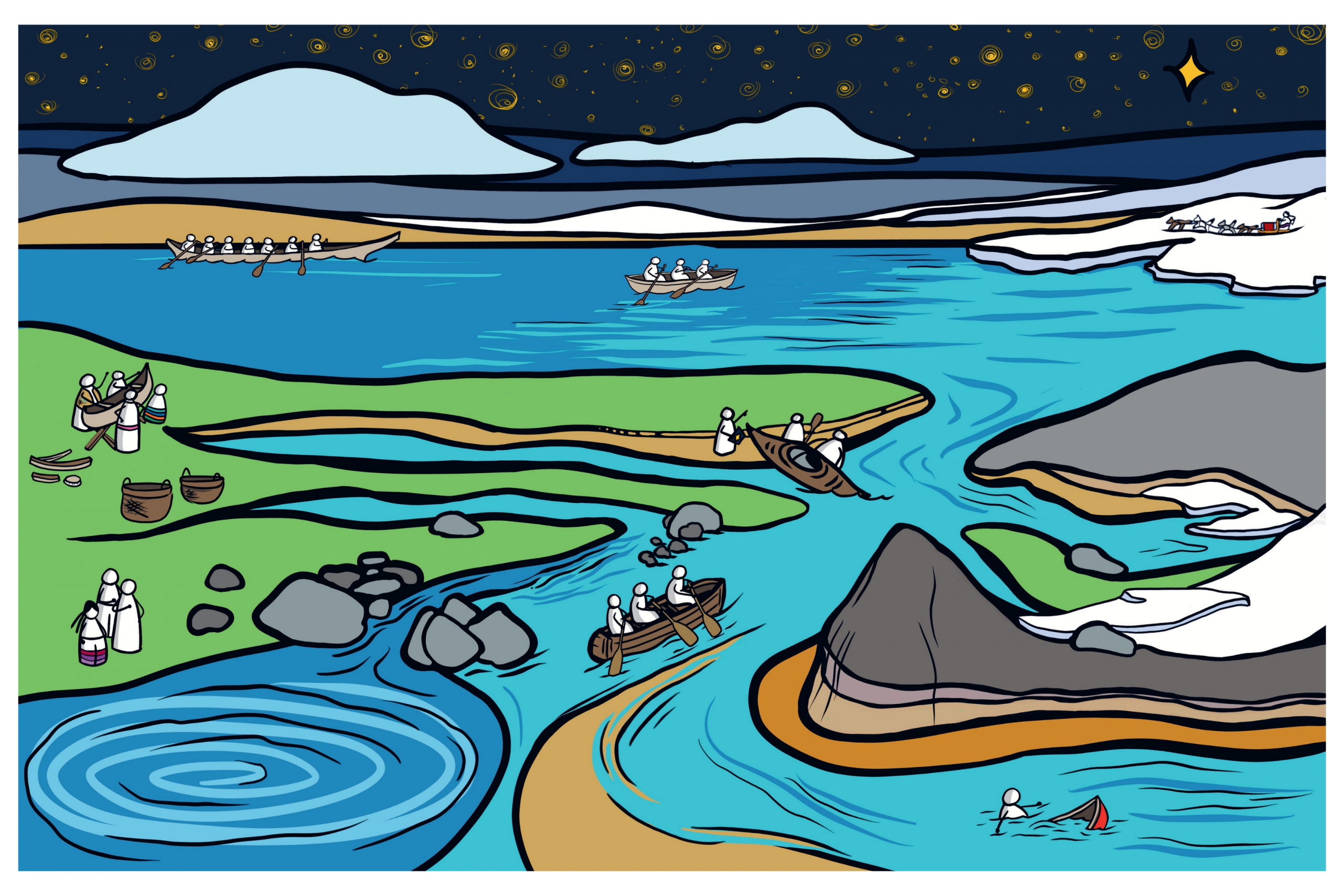
Artwork by Jessica Plummer, Bridge Building Group
Read the Official Statement
Marking the launch of the Fluency and Immersion Teacher Education Roadmap on National Indigenous Languages Day.
View StatementFor more information, contact:
For questions about the Commission, our mandate, or for any other inquiries, please contact us at general.inquiries@ocil-ila.ca